
There’s a recipe I make when someone needs a little more than a Tuesday can give. Not a layered occasion cake. Not something that requires three different bowls and a stand mixer running for twenty minutes. Just something warm, golden, and cut into generous squares — the kind you bring to the table still slightly warm, with the glaze barely set and the kitchen smelling like caramel and toasted nuts. This southern banana nut cake is that recipe.

It bakes in a 9×13-inch pan, feeds a crowd without asking much from you, and gets genuinely better the next day. The toasted pecans and brown butter glaze are what make it unmistakably Southern — and unmistakably worth every step.
If you usually reach for a simple everyday banana loaf on a slow morning, this one is its richer, nuttier cousin — and it earns its place at any table.
Why You’ll Love This Banana Nut Cake Recipe
This easy banana nut cake hits everything you want in a family bake — and asks almost nothing of you in return.
- One pan, zero fuss. A 9×13-inch sheet cake means no stacking, no leveling, no assembly. You pour the batter, you bake, you glaze. Done.
- An incredibly moist crumb — for days. The combination of buttermilk, real butter, and a touch of neutral oil keeps every slice tender and soft long after the first bake. This is not a cake that dries out by day two.
- Toasted pecans in every bite. We toast the nuts before they go into the batter. It takes eight minutes and changes everything — deeper flavor, better crunch, no sogginess in the crumb.
- That brown butter glaze. Warm and caramel-kissed, poured directly over a still-warm cake. It soaks into the very top of the crumb, sets into something between a glaze and a candy shell, and makes every slice taste like it came from a Southern grandma’s kitchen.
- Ripe bananas do the sweetening. The riper your bananas, the better the cake. You won’t need to lean on extra sugar when your bananas have done the work for you.
Ingredients & Notes
Here is everything you need — and why each one matters. No filler ingredients here.
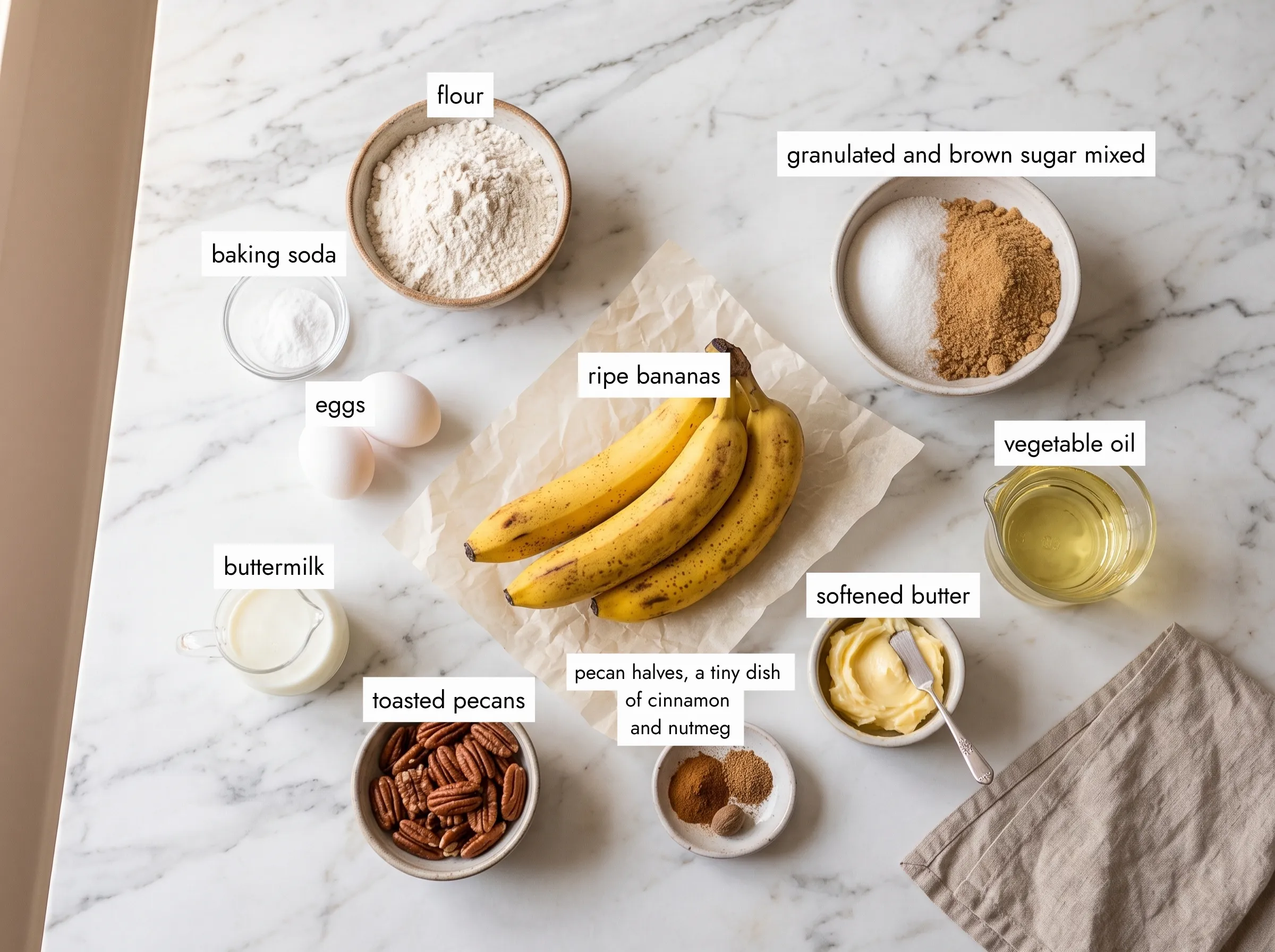
Wet Ingredients
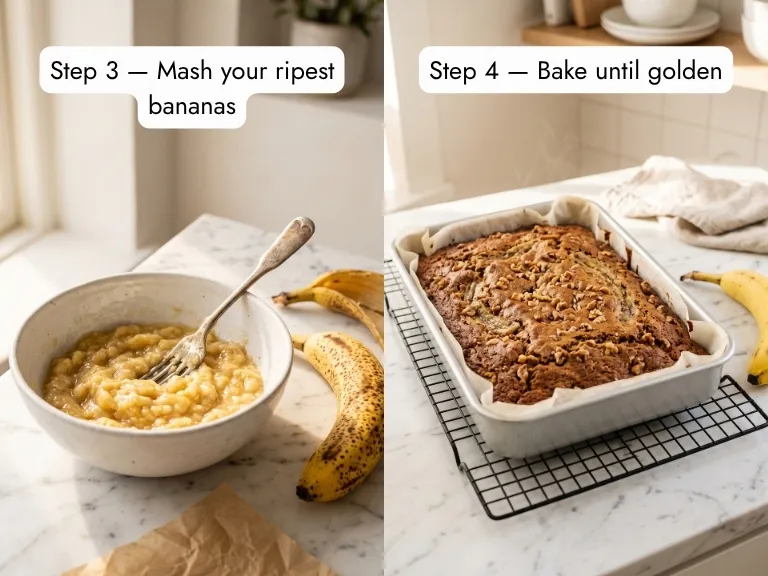
Ripe bananas — 1½ cups mashed (about 3 to 4 bananas). Use the ones with brown spots covering the skin. Brown-spotted bananas contain up to 80% more natural sugar than yellow ones — they sweeten the batter naturally and keep the crumb soft for days. Mash them well with a fork for a little texture, or blend them smooth for a more uniform crumb. Both work.
Unsalted butter — ½ cup (115g), softened. Real butter gives the cake its depth of flavor. It needs to be genuinely soft — leave it out for 30 to 45 minutes before you start. You should be able to press a finger in easily. If it’s too cold, the creaming step won’t work properly and the texture suffers.
Canola or vegetable oil — ¼ cup (60ml). Butter gives flavor; oil gives moisture. This combination is exactly why the cake stays tender even on day three. Don’t substitute all-butter — the oil is doing structural work here.
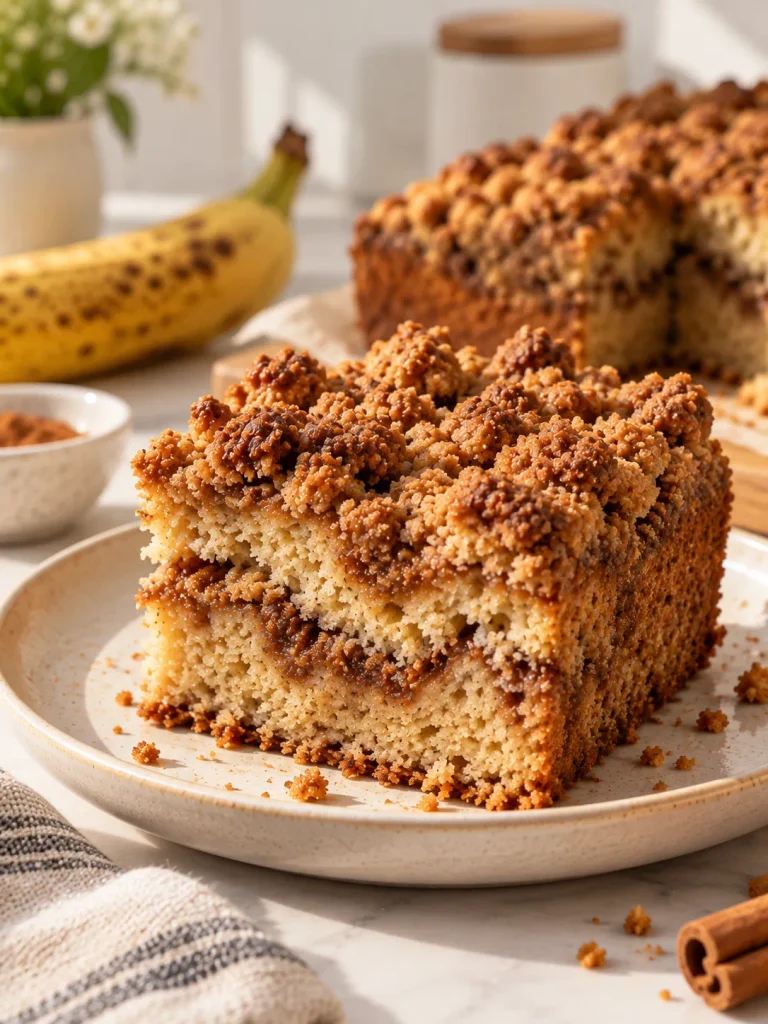
Buttermilk — 1 cup (240ml), room temperature. The acid in buttermilk activates the baking soda and creates a tender, open crumb. It also adds a subtle tang that balances the sweetness of the banana and the glaze. If you love this kind of warming weekend bake, our banana coffee cake with streusel uses the same buttermilk base for a brilliant brunch version.
No buttermilk? Stir 1 tablespoon of white vinegar or lemon juice into 1 cup of whole milk. Let it sit for 5 minutes before using. Works perfectly every time.
3 large eggs, room temperature. Cold eggs can cause the batter to separate slightly. Set them out when you set out the butter — 30 minutes before you start.
Pure vanilla extract — 1 tsp. Use real vanilla. It rounds out the banana and the warm spices in a way that imitation extract simply doesn’t replicate.
Dry Ingredients
All-purpose flour — 2½ cups (315g). Measure correctly: spoon the flour into the measuring cup and level it off with a straight edge. Scooping directly from the bag packs too much in and leads to a dense, dry crumb.
Granulated sugar — 1½ cups (300g) + light brown sugar — ½ cup (100g). Using both matters. Granulated sugar gives structure and lift. Brown sugar adds a subtle molasses warmth that plays beautifully against the brown butter glaze — it’s the same flavor logic that makes a good banana cake recipe feel more complex than the sum of its parts.
Baking soda — 1 tsp + baking powder — ½ tsp. Both, together. The buttermilk activates the soda; the double-acting powder provides additional lift. Don’t swap or reduce either.
Fine salt — ½ tsp. Salt is non-negotiable in a sweet bake. It makes every other flavor louder.
Ground cinnamon — ½ tsp + ground nutmeg — ¼ tsp. Subtle. They warm the background without announcing themselves. A traditional Southern touch that you’d miss if it were gone.
Toasted Pecans
Pecans — 1 cup (120g) for the batter + ½ cup (60g) for the topping, roughly chopped.
Toast all of them together at the start. Toasted nuts release their natural oils, deepen in flavor, and — critically — stay crunchy inside a moist batter. Raw pecans absorb moisture and turn soft. Do not skip this step.
Walnuts instead? Yes. Use the same quantity and toast them the same way. Walnuts bring a slightly more bitter, earthier note than pecans — they make this a classic banana walnut cake in the American tradition. Both versions are wonderful.
For the Brown Butter Pecan Glaze
Unsalted butter — ½ cup (115g). This gets browned in a saucepan over medium heat. Use a light-colored pan so you can watch the color as it changes — dark pans hide the browning and make it easy to burn.
Light brown sugar — 1 cup (200g), packed. The base of the glaze and the source of its deep caramel flavor. Pack the sugar firmly into the measuring cup.
Whole milk or heavy cream — ⅓ cup (80ml). Cream makes a richer, glossier glaze. Milk works too and is slightly lighter. Either is fine.
Powdered sugar — 1½ cups (180g), sifted. Sift it before it goes into the glaze. Lumps in the powdered sugar mean lumps in the finish, and this glaze deserves to be smooth.
Pure vanilla extract — 1 tsp.
Finely chopped toasted pecans — ½ cup (60g). These go on top of the glaze before it sets, adding crunch and making the cake look exactly like what it is — a proper Southern dessert.
How to Make This Southern Banana Nut Cake
This cake comes together in one bowl — no mixer needed. You’ll toast the pecans first (that step matters more than you think), then mix everything by hand, bake until golden, and finish with a warm brown butter glaze that soaks right into the top. Four simple moves. The whole kitchen smells incredible by the time you’re done.
Step 1 — Toast the Pecans First
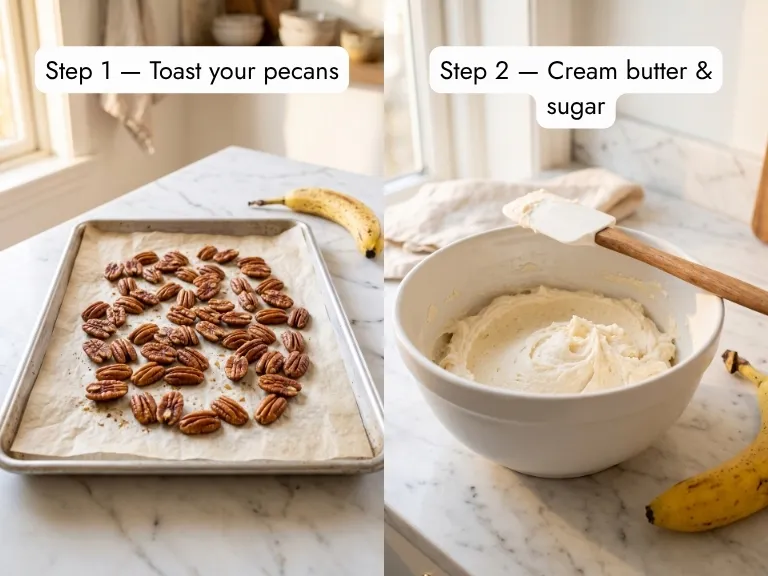
Preheat your oven to 350°F (175°C). Spread all of the pecans — the full 1½ cups for both the batter and the topping — on a dry, rimmed baking sheet in a single layer. Slide them into the oven for 6 to 8 minutes.
They’re ready when they smell distinctly nutty and toasted and look lightly golden. Pull them out and let them cool completely on the pan. Once cool, roughly chop the 1-cup portion going into the batter, and finely chop the ½-cup portion for the topping. Keep them separate.
Don’t walk away during this step. Toasted nuts go from perfect to burnt in about 90 seconds once they’re at temperature.
Step 2 — Prep Your Pan and Mix the Dry Ingredients
Butter and flour a 9×13-inch baking pan, or line it with parchment paper leaving a 2-inch overhang on both long sides. The parchment overhang works as handles — it makes lifting the whole cake out and slicing it into clean squares much easier.
In a large mixing bowl, whisk together the flour, baking soda, baking powder, salt, cinnamon, and nutmeg until the spices are evenly distributed throughout the flour. Set aside.
Step 3 — Cream the Butter, Oil & Sugars
In the bowl of a stand mixer fitted with the paddle attachment — or using a hand mixer and a large bowl — beat the softened butter, oil, granulated sugar, and brown sugar together on medium speed for 3 full minutes.
You’re looking for a pale, noticeably fluffy mixture. Don’t rush this step. It’s building air and structure into the crumb. At 1 minute it still looks dense and yellow. By 3 minutes it should be almost ivory-colored and visibly lighter in texture.
Step 4 — Add the Eggs, Vanilla and Mashed Bananas
Add the eggs one at a time, beating well on medium speed after each addition and scraping down the sides of the bowl between additions. Then add the vanilla extract. Finally, add the mashed bananas.
A Note on What Happens Here
The batter may look slightly broken or curdled after the bananas go in. That’s completely normal. The high water content of the bananas temporarily disrupts the emulsion — it comes back together once the flour is incorporated. Don’t add more flour.
Step 5 — Alternate Flour and Buttermilk
Reduce the mixer speed to low. Add the flour mixture in three additions, alternating with the buttermilk in two additions — flour, buttermilk, flour, buttermilk, flour. Begin and end with the flour.
Mix only until just combined after each addition. Overmixing after the flour goes in develops the gluten and tightens the crumb. A few faint streaks of flour are fine going into the last fold — they disappear on their own.
Using a rubber spatula, gently fold in the roughly chopped toasted pecans by hand. Two or three slow folds are enough.
Step 6 — Bake
Pour the batter into your prepared 9×13-inch pan and smooth the surface with a spatula. It’s a thick batter — coax it into the corners.
Bake at 350°F (175°C) for 35 to 40 minutes. Start checking at 33 minutes. The cake is done when a toothpick inserted in the center comes out with a few moist crumbs attached — not wet batter, not completely clean. The top should be deep golden and the edges should be just beginning to pull away from the sides of the pan.
Let the cake rest on a wire rack for 15 minutes while you make the glaze. You want it warm, not hot, when the glaze goes on.
Step 7 — Make the Brown Butter Pecan Glaze
This glaze is what makes this recipe worth making. It takes 7 minutes and it transforms the cake from very good into something people ask you for the recipe afterward.
How to Brown Butter Without Burning It
Use a medium, light-colored saucepan — stainless steel or enameled. A dark pan makes it impossible to see the color of the butter as it changes.
Melt the butter over medium heat. It will go through several stages: melting, then foaming, then the foam will subside slightly and you’ll start to hear a crackling, spitting sound. That’s the water evaporating. Keep watching. Tiny golden-brown specks will appear on the bottom of the pan — that’s the milk solids caramelizing. The moment you smell something nutty and toasty — almost like hazelnuts — pull the pan off the heat immediately.
This takes about 4 to 5 minutes total. Do not leave the stove.
Finishing the Glaze
Immediately add the packed brown sugar and the milk or cream directly to the browned butter in the hot pan — it will bubble and steam. Return to medium heat and bring to a gentle simmer, whisking constantly, for exactly 1 minute.
Remove from heat. Stir in the vanilla extract. Whisk in the sifted powdered sugar until the glaze is completely smooth, glossy, and pourable. Work quickly — it thickens as it cools.
Step 8 — Pour, Spread and Finish
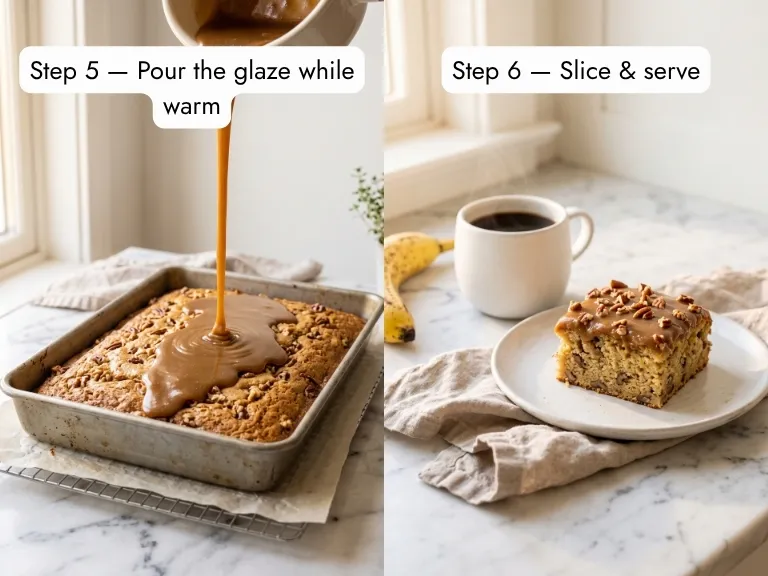
Pour the warm glaze immediately over the still-warm cake. Use an offset spatula or the back of a large spoon to spread it quickly and evenly to all four edges.
Scatter the finely chopped toasted pecans over the surface of the glaze before it sets. Press them in very gently if needed.
Let the cake rest undisturbed for at least 30 minutes before slicing. The glaze needs time to set from glossy to a soft, fudgy surface. Cut into squares with a sharp knife, wiping the blade between cuts for clean edges.
The glaze sets firm on the surface but stays almost fudgy just beneath — that’s exactly what you want. That’s the Southern baker’s reward.
Lily’s Tips for the Perfect Result
Always toast your pecans. This is non-negotiable. Raw pecans go soft and faintly bitter inside a moist batter. Toasted ones stay crunchy and develop an almost caramel-like depth that makes every bite more complex.
“The riper your bananas, the less sugar you’ll need — nature does the sweetening for you.”
Don’t overbake. Pull the cake when the toothpick comes out with a few moist crumbs — not clean. The cake continues to cook as it cools on the wire rack, and those last few degrees of residual heat are what keep the center tender rather than dry.
Glaze on a warm cake, not a cold one. A warm cake absorbs a thin layer of the glaze into the crumb surface itself, creating a fudgy seal that actually makes the cake more moist on day two than on day one. This is the move.
Make it the day before. This banana nut cake genuinely improves overnight. The glaze soaks deeper, the banana flavor intensifies, and every square tastes like it came from a bakery window at 7am. Make it on Friday for Saturday. Make it Saturday for Sunday. You will be glad you did.
Use a light-colored pan for the glaze. A dark or non-stick pan makes it nearly impossible to monitor the color of the browning butter. The difference between perfect brown butter and burnt butter is about 30 seconds — a light pan is your safety net.
Brown-spotted bananas contain up to 80% more natural sugar than yellow ones — which means less work for you and a naturally sweeter crumb.
Variations
Banana Nut Cake with Cream Cheese Frosting
If you prefer a cold, tangy frosting over a warm caramel glaze, skip the brown butter version entirely. Make a classic cream cheese frosting: beat 8oz (225g) full-fat cream cheese with ½ cup (115g) softened butter, 2 cups (240g) sifted powdered sugar, and 1 teaspoon vanilla until fluffy and smooth. Spread over a completely cooled cake and top with pecans.
For the full cream cheese frosted banana cake experience without the nuts, our classic banana cake with cream cheese frosting is exactly that — lighter crumb, no nuts, beautifully white frosting.
Walnuts Instead of Pecans — Classic Banana Walnut Cake
Pecans are the Southern standard, but walnuts bring this into classic banana walnut cake territory. Use the exact same quantities and toast them the same way. Walnuts are slightly more bitter and earthy, which balances beautifully against the sweetness of very ripe bananas and the brown sugar glaze. Either nut makes a wonderful cake.
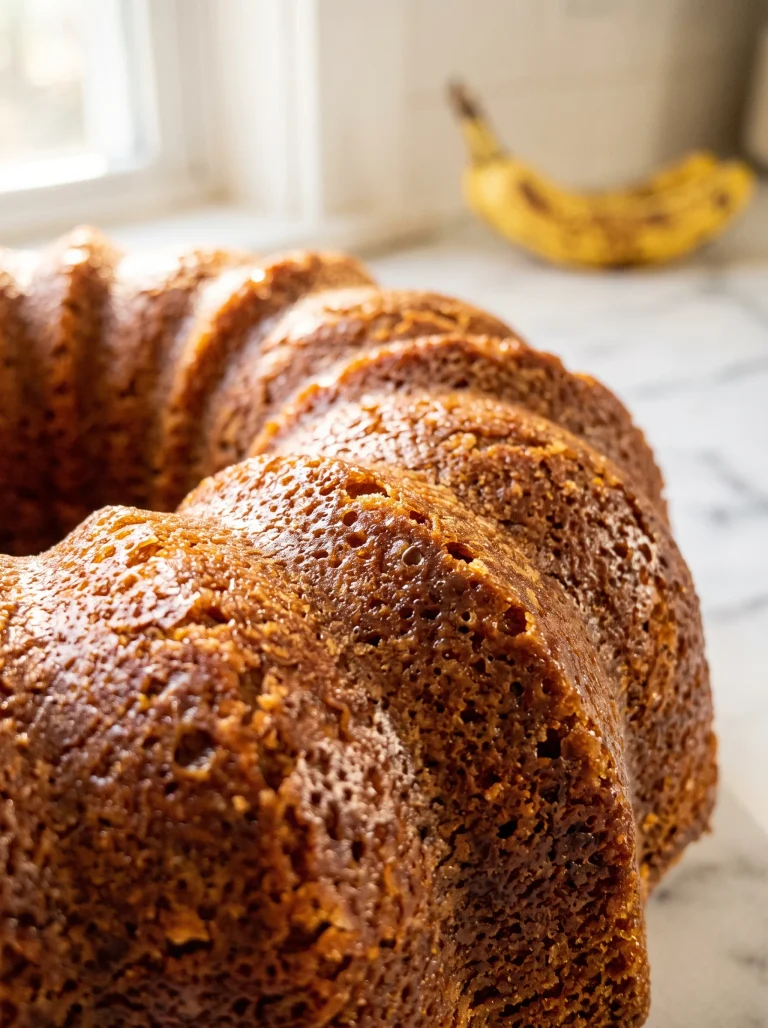
Banana Nut Bundt Cake
Want a more decorative presentation? Pour this same batter into a well-greased and floured 12-cup bundt pan. Bake at 350°F (175°C) for 50 to 60 minutes — start checking at the 50-minute mark. Let it cool in the pan for 15 minutes, then turn out onto a rack. Drizzle the warm glaze over the top. For a fully tuned bundt approach, our banana bread bundt cake has its own method built for the shape.
Bourbon Banana Nut Cake
Add 1 tablespoon of good Kentucky bourbon to the batter alongside the vanilla, and another teaspoon into the finished glaze. The alcohol bakes off in the oven but leaves a warm, rounded note that makes the whole cake taste more complex — and distinctly more Southern.
Sheet Pan Crunch Version
Double the pecan topping — use a full cup of finely chopped toasted pecans on the glaze instead of half. The crunch-to-soft contrast in every bite becomes the whole point. This is the version for people who are specifically here for texture.
How to Store
Counter: Up to 4 days — the brown butter glaze acts as a barrier that keeps the surface moist and protected. Cover the pan tightly with plastic wrap or transfer slices to an airtight container.
Fridge: Up to 6 days in an airtight container. Let slices come to room temperature for 20 minutes before serving — cold temperatures firm up the crumb and mute the banana flavor slightly.
Freezer: Up to 3 months. Freeze individual squares wrapped tightly in plastic wrap, then placed in a zip-lock freezer bag. Thaw at room temperature for 1 to 2 hours. The glaze softens back to its original fudgy texture beautifully.
Meal prep tip: Bake this cake one day ahead — the flavors deepen overnight as the glaze soaks into the crumb. It is genuinely better on day two than fresh out of the oven.
One Last Thing Before You Slice
If you’ve never made a Southern sheet cake before, this is the one to start with. It forgives a little imprecision. It rewards very ripe bananas. And it makes your kitchen smell like something worth staying home for.
Cut it into big squares, pour yourself something warm, and share it with whoever’s nearby.
Tag me on Instagram @eatwithmellow or leave a star rating below — I love seeing your kitchens.
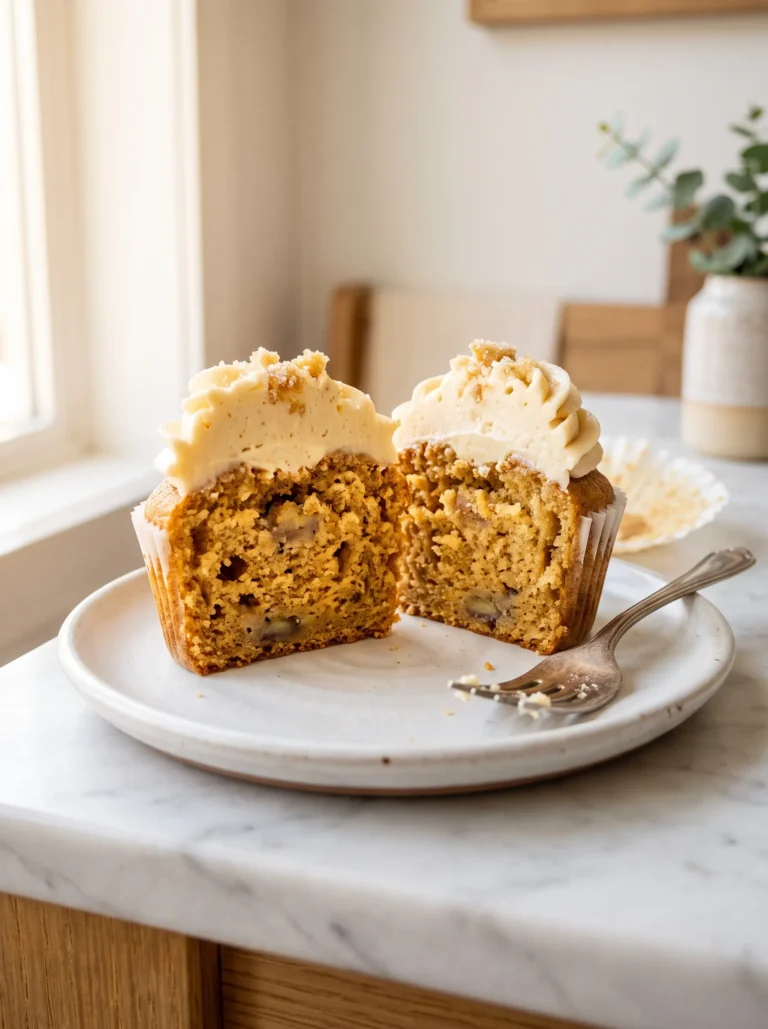
If you love this, try our tender banana cupcakes with buttercream for an individual-serve version, or our caramelized banana upside down cake for your next dinner party showstopper.
Love, Lily 🍌
Want to save this recipe?
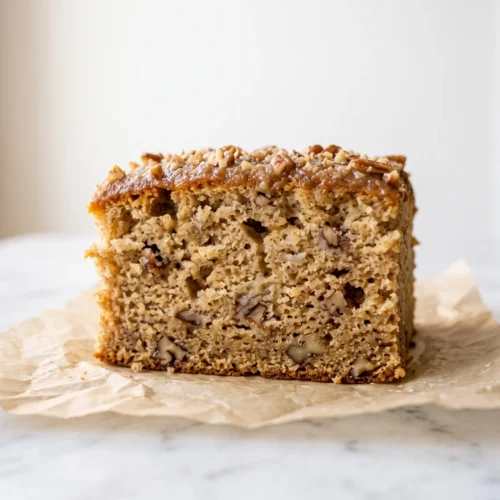
Moist Southern Banana Nut Cake
Equipment
- 9×13 inch baking pan
- Stand mixer or hand mixer
- Medium light-colored saucepan
- Large mixing bowl
- Wire cooling rack
- Offset spatula
- Rimmed baking sheet (for pecans)
Ingredients
WET INGREDIENTS
- 3 large eggs room temperature
- ½ cup 115g unsalted butter, softened to room temperature
- ¼ cup 60ml canola or vegetable oil
- 1½ cups 300g granulated sugar
- ½ cup 100g packed light brown sugar
- 1½ cups 340g mashed very ripe bananas (about 3–4 bananas)
- 1 cup 240ml real buttermilk, room temperature
- 1 tsp pure vanilla extract
DRY INGREDIENTS
- 2½ cups 315g all-purpose flour
- 1 tsp baking soda
- ½ tsp baking powder
- ½ tsp fine salt
- ½ tsp ground cinnamon
- ¼ tsp ground nutmeg
MIX-INS
- 1 cup 120g pecans or walnuts, toasted and roughly chopped
BROWN BUTTER PECAN GLAZE
- ½ cup 115g unsalted butter
- 1 cup 200g packed light brown sugar
- ⅓ cup 80ml whole milk or heavy cream
- 1 tsp pure vanilla extract
- 1½ cups 180g powdered sugar, sifted
- ½ cup 60g toasted pecans, finely chopped
Instructions
- Toast the pecans. Preheat oven to 350°F (175°C). Spread all pecans on a rimmed baking sheet. Toast for 6–8 minutes until fragrant and golden. Cool completely. Roughly chop 1 cup for the batter and finely chop ½ cup for the topping.
- Prep the pan. Butter and flour a 9×13-inch baking pan or line with parchment paper, leaving overhangs on both long sides.
- Mix the dry ingredients. In a large bowl, whisk together flour, baking soda, baking powder, salt, cinnamon, and nutmeg. Set aside.
- Cream butter and sugars. In a stand mixer with paddle attachment, beat softened butter, oil, granulated sugar, and brown sugar on medium speed for 3 minutes until pale and fluffy.
- Add eggs and bananas. Add eggs one at a time, beating well after each. Mix in vanilla extract, then mashed bananas. Batter may look slightly curdled — that’s normal.
- Alternate flour and buttermilk. With mixer on low, add flour in 3 additions alternating with buttermilk in 2 additions, starting and ending with flour. Mix until just combined. Fold in 1 cup toasted pecans by hand with a spatula.
- Bake. Pour into prepared pan and smooth the top. Bake at 350°F (175°C) for 35–40 minutes, until a toothpick inserted in the center comes out with a few moist crumbs. Cool on a wire rack for 15 minutes.
- Brown the butter. In a light-colored saucepan over medium heat, melt ½ cup butter. Cook, swirling occasionally, until golden-brown specks appear on the bottom and the butter smells nutty, about 4–5 minutes. Remove from heat immediately.
- Make the glaze. Add brown sugar and milk or cream to the browned butter. Return to medium heat, bring to a gentle simmer, and whisk constantly for 1 minute. Remove from heat, stir in vanilla, then whisk in sifted powdered sugar until completely smooth and glossy.
- Glaze and finish. Pour warm glaze immediately over the warm cake. Spread quickly to the edges. Scatter finely chopped toasted pecans over the top before the glaze sets. Rest for 30 minutes before slicing into squares.
Notes
Cover tightly and store at room temperature up to 4 days, in the refrigerator
up to 6 days, or freeze individual slices (wrapped in plastic wrap, then in a
freezer bag) up to 3 months. Thaw at room temperature for 1–2 hours. Note 2 — Buttermilk substitute:
No buttermilk? Stir 1 tablespoon of white vinegar or lemon juice into 1 cup
of whole milk. Let sit 5 minutes before using. Note 3 — Nut substitution:
Walnuts work in place of pecans at a 1:1 ratio. Toast them the same way. They
bring a slightly more bitter, earthy flavor that pairs beautifully with ripe
bananas.